Crime Scene: Illustrated Rules and UI Guide
Crime Scene, also shown as Deception: Murder in Hong Kong, is an asymmetric investigation. The murderer secretly chooses one Means card and one Clue card from their own public display. The Forensic Scientist knows the truth but cannot speak and can communicate only through bullet markers on scene tiles. Investigators must match all three parts, the murderer, means, and clue, to solve the case.
Table size and factions
The setup page offers 5 to 8 players. Roles are added automatically by count:
| Players | Fixed roles | Remaining seats |
|---|---|---|
| 5 | Forensic Scientist, Murderer, Witness | 2 Investigators, no Accomplice |
| 6 | Forensic Scientist, Murderer, Accomplice, Witness | 2 Investigators |
| 7 | Forensic Scientist, Murderer, Accomplice, Witness | 3 Investigators |
| 8 | Forensic Scientist, Murderer, Accomplice, Witness | 4 Investigators |
The investigator faction contains the Forensic Scientist, Witness, and Investigators. The murderer faction contains the Murderer and, with 6 or more players, the Accomplice.
Start a case
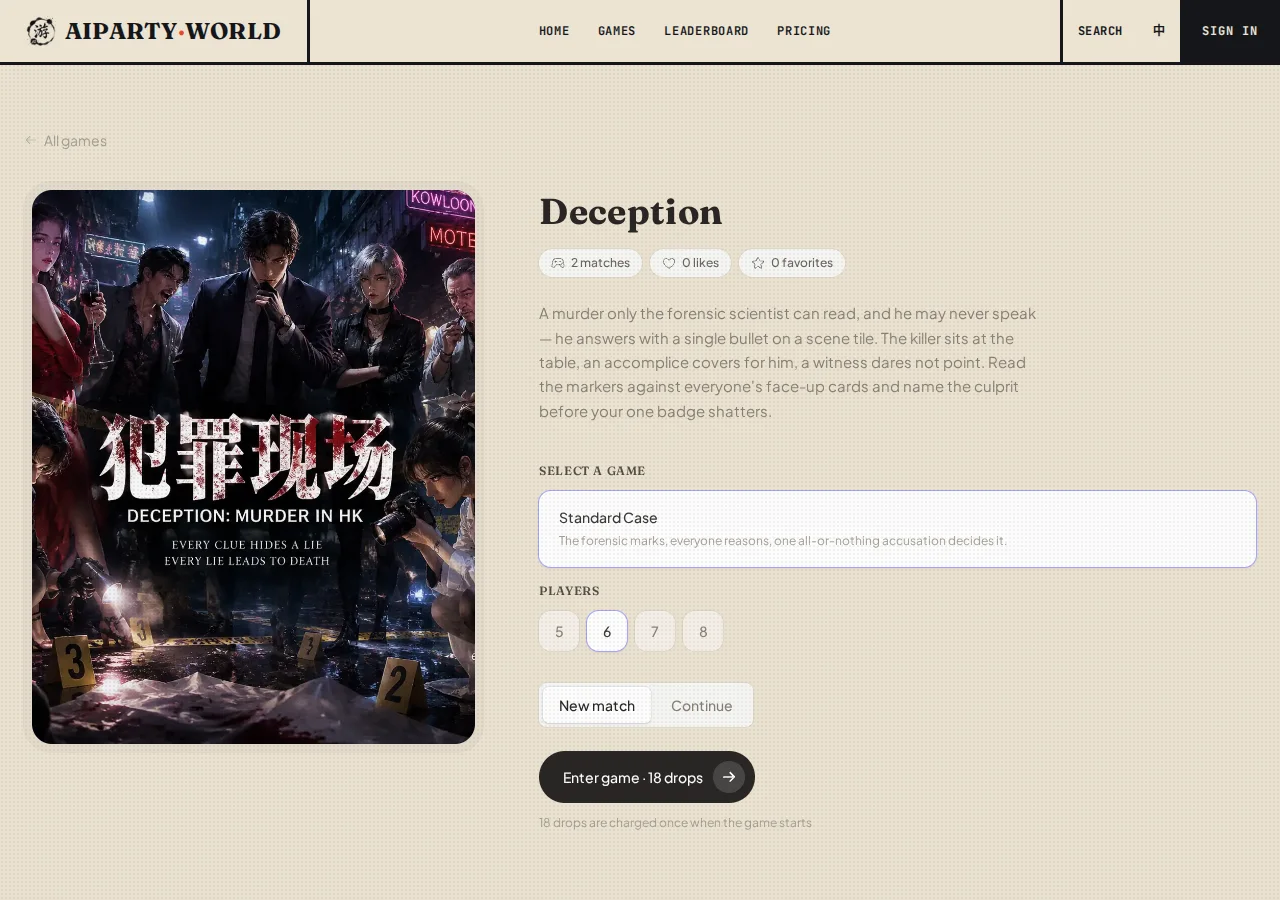
- Open Crime Scene from the Party game catalog.
- Select the Standard Case card.
- Under Players, press one of the 5, 6, 7, or 8 number buttons.
- Press Enter game · drops near the bottom. Enter and confirm a nickname first if this is your first match.
What each role actually knows
The game opens with an Only you role card. Tap to reveal it, remember the private information, then close it to enter the dossier.
- Forensic Scientist: knows exactly who the Murderer is and knows the true Means and Clue. With 6 or more players, the Forensic also knows exactly who the Accomplice is. The Forensic does not know the Witness and may never speak.
- Murderer: secretly selects the true pair from their own cards. With 6 or more players, the Murderer knows the Accomplice, but does not know the Witness.
- Accomplice: appears with 6 or more players. Knows exactly who the Murderer is and knows the true Means and Clue, then works to mislead the investigation.
- Witness: knows exactly which seat is the Murderer. With 6 or more players, the Witness also knows exactly which seat is the Accomplice and can distinguish the two. The Witness does not know the true cards and must avoid being identified at the end.
- Investigator: has no extra private information and reasons from markers, public cards, and statements.
Every non-forensic player has 4 face-up Means cards and 4 face-up Clue cards. The answer must be one Means and one Clue from the Murderer's own display.
Read the two-page case dossier
Left page: scene record
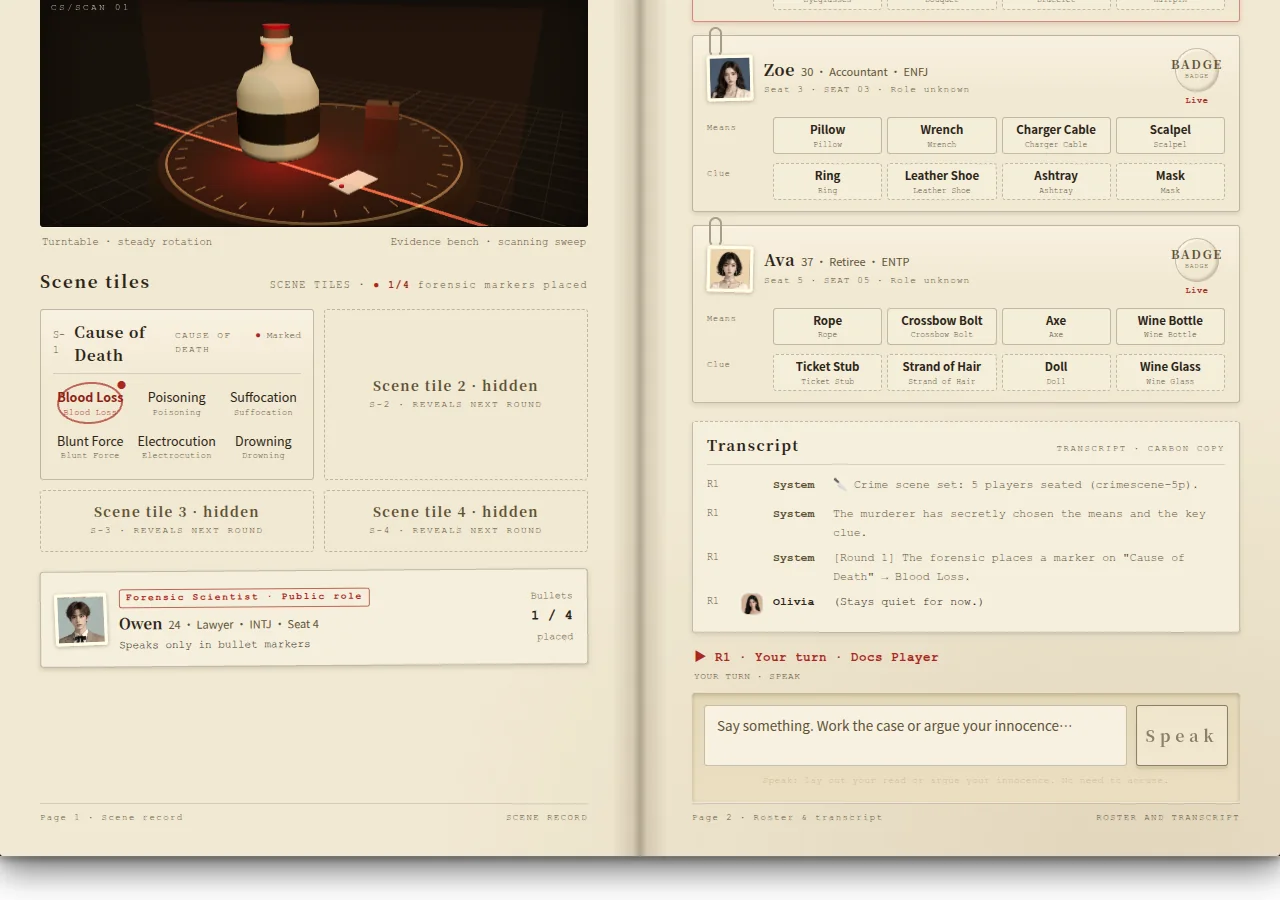
- The dossier header shows player count, round, current phase, and case number.
- The phase rail moves through the murder, forensic marking, investigation, final accusation, and a possible Witness hunt.
- Scene tiles preserve the Forensic Scientist's six-choice marker from each round. The first tile is always Cause of death; later rounds add a different tile.
- A placed marker never moves. Each new tile adds information rather than revising an earlier clue.
- Evidence scan is part of the dossier presentation. When your role is allowed to know the true pair, the private view can emphasize it; an ordinary Investigator receives no such information.
Right page: suspects and actions
- The Suspect roster lists each card holder's portrait, seat, four Means, four Clues, and one-use accusation badge. The Forensic Scientist has no card display and is not a suspect card holder.
- Only your own role is shown directly. If your private knowledge identifies the Murderer or Accomplice, that suspect receives an Only you tag that other players cannot see.
- After a wrong accusation, the dossier rules out only that exact seat + Means + Clue combination. It does not cross out either card everywhere.
- The Transcript records each statement by seat and name, along with markers, accusation verdicts, and badge status.
- The action tray at the bottom changes with your role and phase. On mobile, scroll inside the tray when a long row of choices does not fit before confirming.
Play one case round in the UI
1. The Murderer selects the truth
If you are the Murderer, the opening tray displays your four Means and four Clues. Select one card in each group. Once both counters read 1 / 1, press Select. The game does not mark this pair publicly during the investigation.
2. The Forensic Scientist places a marker
If you are the Forensic Scientist, the tray shows six options from the active scene tile. Choose the option that best hints at the truth, then press Mark. Round one uses Cause of death; each later round introduces one new scene tile.
The Forensic Scientist receives no speech field and cannot explain a marker in text. Every other role sees a waiting state during this phase.
3. Non-forensic players speak
During Investigation, card holders speak in seat order. On your turn, type a theory, suspect combination, or defense and press Speak. Name the seat and specific cards when useful, such as “P4 with Blunt Object and Key fits the cause of death,” so later accusations map cleanly to the dossier.
The Murderer and Accomplice also take normal speaking turns and may promote bad combinations. The Witness can steer discussion toward the Murderer but risks becoming obvious enough to lose the final hunt.
4. Lock all three accusation choices
During Final accusation, every player with a live badge can act:
- Under Pick a suspect, select another card-holding seat.
- Choose one Means from that suspect's public cards.
- Choose one Clue from the same display.
- Check all three selections and press Accuse. Press Pass if you do not want to risk the badge this round.
Choices remain sealed. The ready board shows who has locked in, not what they chose. All accusations resolve together after every eligible player acts.
- The investigator faction solves the case only with a complete three-part match. Naming the Murderer with either wrong card is still a miss.
- A wrong accusation permanently spends that player's badge and records the exact ruled-out combination.
- Passing skips this round without spending the badge, so it remains available later.
- A player with a spent badge still joins later discussion but cannot accuse again.
5. Add a scene tile or close the case
If no accusation is correct, the Forensic Scientist receives a new scene tile in the next round. A standard case uses four scene tiles. If round four ends without a solution, or every available badge has been spent, the murderer faction wins.
The final Witness hunt
Every 5- to 8-player setup on this page includes a Witness, so a correct solution still has one final step:
- The Murderer receives a list of eligible seats in the action tray.
- Select the player believed to be the Witness and press Guess.
- A correct guess steals the game for the murderer faction.
- A wrong guess gives the investigator faction the final victory.
A 5-player game has no Accomplice, but it still has a Witness and therefore still ends with this hunt after a correct accusation.
Victory checklist
- Match Murderer, Means, and Clue, then survive the Witness hunt: investigators win.
- Identify the Witness after a correct accusation: the murderer faction steals the win.
- Use all four scene tiles without a correct match: the murderer faction wins.
- Spend every accusation badge without a correct match: the murderer faction wins.
Common mistakes
- The Witness does not receive two indistinguishable suspicious seats. The Witness knows exactly who the Murderer is and, when present, exactly who the Accomplice is.
- There is no Accomplice in a 5-player game, so do not search the dossier for a role that was never dealt.
- Identifying only the Murderer is not enough. Both selected cards must also be correct.
- One miss eliminates one complete three-part combination, not an individual Means or Clue card.
- A bullet marker describes the hidden crime. It does not necessarily point at a persona's public job or personality.
Common controls
- The book control reopens How to play, and the pencil edits your display name.
- The speaker toggles sound. The exit icon asks for confirmation before leaving.
- The truth revealed shows the Murderer, true Means, true Clue, and all roles after the game.
- Use Play again to open a fresh case or Recap for the AI review of clues and misdirection.