Liar's Dice: Illustrated Game Guide
Liar's Dice is a game of probability and nerve. You see only your own dice, yet every bid makes a claim about all hidden dice at the table. Tell the truth, stretch the odds, or bluff outright. The round ends when someone challenges the previous bidder and every cup opens.
Before the match: players and mode
Set up two things on the game page:
- Choose 2 to 6 players. Everyone starts with 5 dice and 3 hearts. You are the only human; the other seats are AI players with distinct personas and playstyles.
- Choose Classic Bluff or Wilds & No-Wilds. The two modes count 1s and order raises differently.
Confirm your nickname and start. Every living player secretly rolls 5 fresh dice at the beginning of each round, and only your own hand is visible to you.

Goal and round flow
Each player has 3 hearts. The loser of a challenge loses 1 heart, and a player at zero hearts is eliminated. The last player with hearts wins.
Each round follows this sequence:
- Every living player rolls in secret.
- The opener makes a “quantity × face” bid.
- Players continue in seat order, either making a legal raise or challenging the previous bidder.
- A challenge opens every cup and determines the loser.
- The loser opens the next round. If that player was eliminated, the next living seat opens instead.
Reading the table
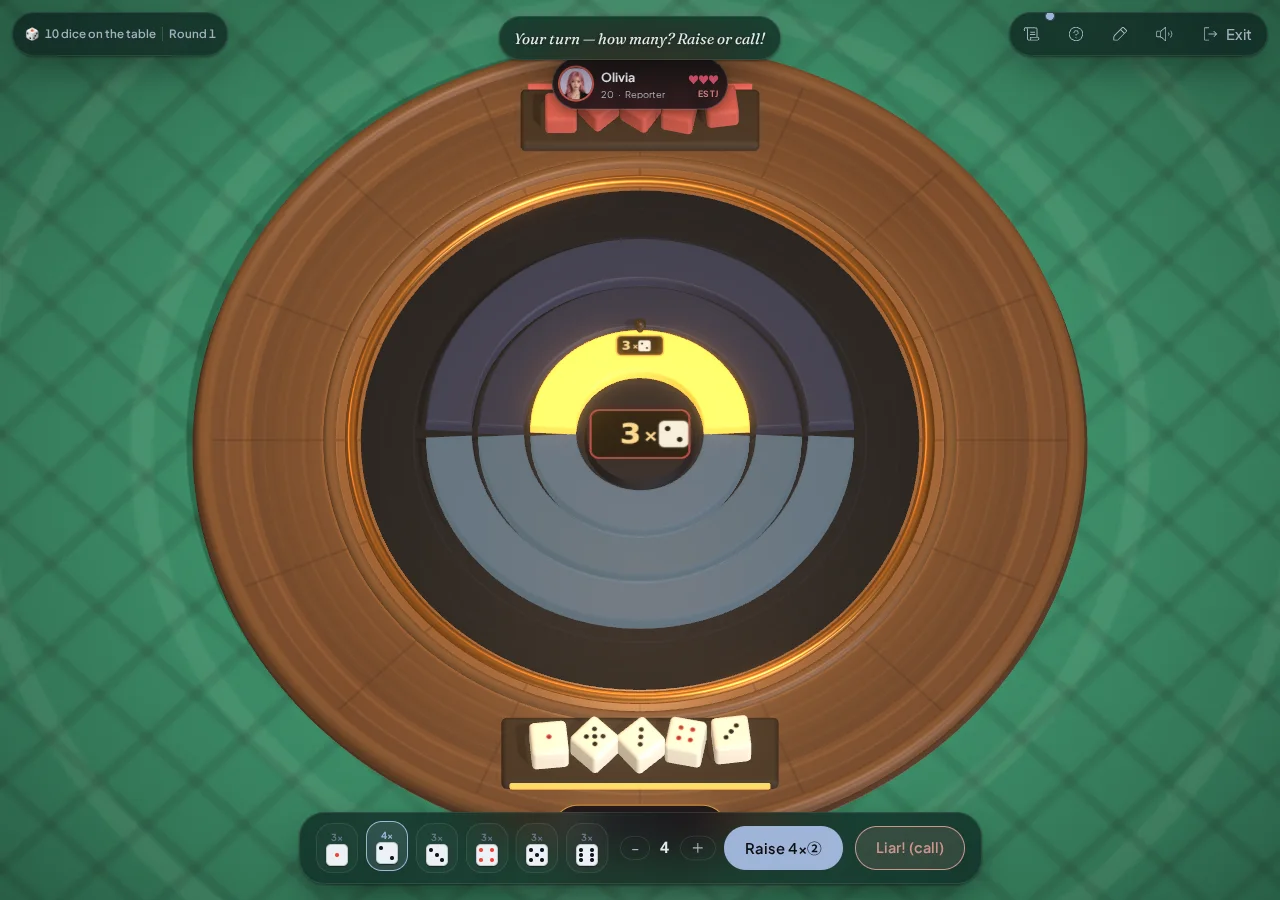
- The upper-left status shows the number of dice still in play and the current round.
- The upper-right controls open the Log and tutorial, change your name, control sound, and exit. A dot on the Log icon means new actions are available to read.
- The center of the table shows the current bid. Avatars, names, and hearts sit beside each player's position, while your five dice appear on the near tray.
- The six face cards at the bottom each show an
n×value. That number is the smallest legal quantity if you select that face, not a bid that has already been sent. - The minus and plus buttons adjust quantity above its legal minimum. Raise submits the displayed combination. Call Liar challenges the last bid.
- Wilds & No-Wilds adds a No wilds switch. In Classic, the UI displays No wilds locked after a bid of 1 locks the round.
A disabled Raise button means the displayed combination cannot beat the current bid. Selecting another face automatically moves the quantity to that face's cheapest legal raise.
What a bid claims
“4 × 5” claims that at least four dice count as 5 across every living player's hand under the current wilds rule. It is not a claim about your own five dice alone.
Minimum opening bid
- An opening on faces 2 through 6 must have a quantity of at least living players + 1.
- An opening on face 1 may have a quantity equal to the number of living players.
At a 2-player table, the first normal-face bid must be at least three of that face, while two 1s is a legal opening. The floor drops when players are eliminated because it follows the current number of living seats.
Within the same comparison tier, faces rank 2 < 3 < 4 < 5 < 6 < 1, so 1 is the highest face. Every later bid must strictly beat the current one, using the ordering for the selected mode.
Classic Bluff: bidding 1 locks no wilds
Each Classic round begins with wild 1s. On a bid for face 2 through 6, every 1 also counts as the bid face.
As soon as anyone bids face 1, the rest of that round is permanently locked to no wilds:
- A 1 stops substituting for any other face and counts only as a literal 1.
- Later bids on faces 2 through 6 remain no-wilds. The table cannot switch back during the same round.
- Wild 1s return when the next round starts.
Classic compares raw quantity first, then face rank when quantities match. After “3 × 1,” for example, the smallest possible raise must increase the quantity to 4.
Wilds & No-Wilds: effective-value raises
This mode lets you switch between wilds and No wilds on each bid:
- A normal-face bid with wilds has an effective value equal to its quantity.
- A bid on face 1 or any no-wilds bid has an effective value equal to twice its quantity.
The game compares effective value first, then face rank when the values match. “3 × 1” has an effective value of 6, so switching back to a normal face with wilds requires at least “7 × face.” “4 × 5” with wilds does not beat it. The face cards in the action dock calculate these legal minimums for you.
Using Call Liar
On your turn, press Call Liar to challenge the immediately previous bid. Every hand opens, and the game counts dice using that bid's face and wilds state:
- If the actual count is at least the claimed quantity, the bid was true and the challenger loses 1 heart.
- If the actual count is below the claimed quantity, the bid was a bluff and the bidder loses 1 heart.
A challenge always targets the last bidder and cannot be undone. If you are unsure what led to the current bid, open the Log before committing.
Straights and five of a kind
Two hands use special counting at reveal:
- Straight: all 5 dice are different, so that hand contributes 0 to the table count.
- Five of a kind: all 5 dice match. It contributes 6 when its face counts. Five 1s contribute 6 toward another face only while 1s are wild; with no wilds, they remain literal 1s.
There is one direct-loss exception. If the last bidder and the challenger both hold straights, the table count is ignored and the challenger immediately loses 1 heart.
Log and end screen
Open the scroll icon to review every bid, challenge, revealed hand, lost heart, elimination, and round divider. The Log scrolls independently and closing it does not interrupt play.
At the end, the result screen names the winner and preserves the final reveal. The AI recap adds an MVP, turning point, and notes on each player. Play Again returns to setup so you can change player count or mode.
Control reference
- Scroll: open the complete action Log.
- Question mark: reopen the short rules for the current mode.
- Pencil: change your display name.
- Sound: mute or restore audio.
- Exit: confirm and end the current match.
- Face card: select a face and load its minimum legal quantity.
- No wilds: a manual switch only in Wilds & No-Wilds. Classic locking is automatic.
You do not need to memorize every raise conversion for your first game. Read the legal minimum above each face, choose how much risk to take, then decide whether to raise or challenge the last bidder.